
A single AI agent triggers dozens of model calls within seconds. A modified prompt, a new feature, an automated pipeline reacting to an unexpected event: the cost structure suddenly looks different before the first dashboard has even updated.
Organizations are integrating AI ever more deeply into their products, internal tools, and automation. What is often underestimated: AI changes not only the software itself, but also how costs arise and are billed. Traditional cloud workloads grow relatively predictably. AI systems do not.
The Structural Problem: Visibility Comes After the Decision
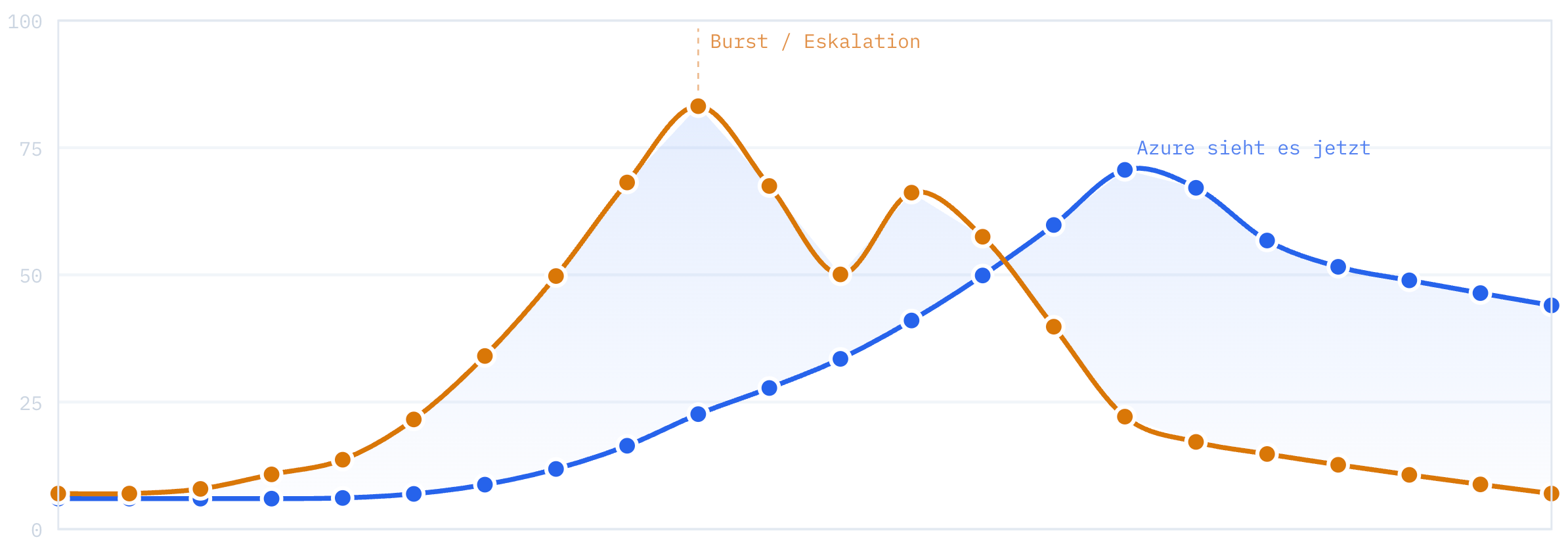
Cloud provider cost management, such as Azure Cost Management, delivers accurate figures, but with a delay that is critical for AI workloads. Microsoft itself points out: cost and usage data typically appears with an 8 to 24 hour delay depending on contract type, and up to 72 hours for pay-as-you-go.
For virtual machines, storage, or traditional infrastructure, this was long acceptable. For AI workloads, it fundamentally changes the risk dynamics:
- Burst usage: Token consumption does not occur linearly, but in bursts. A single AI agent can trigger follow-up processes and additional agents, each initiating their own model calls.
- Speed over transparency: Budget spikes arise in minutes. Visibility into them comes hours or days later.
- Decentralized execution: Different teams, models, and agents run in parallel without a shared real-time cost view.
The actual risk is not the magnitude of individual costs. It is the speed at which they arise, combined with a governance structure that only intervenes after the fact.
Reactive governance is based on the assumption that usage is predictable enough to be controlled retrospectively. For traditional cloud infrastructure, this was defensible. Costs grew linearly, anomalies appeared in daily reports, corrections could take effect before damage became significant.
AI workloads follow a different logic. AI agents make autonomous decisions, call additional agents, initiate tool chains, and trigger follow-up processes that no team planned in advance. Usage does not arise linearly; it arises as a chain reaction. And in precisely these moments, a governance model designed for predictability fails. Tokens are consumed, calls have been made, budgets are exceeded. What remains possible is no longer control. It is damage analysis.
FinOps for AI Is an Architecture Problem, Not a Reporting Problem
FinOps (Financial Operations) describes the discipline of operationally controlling cloud costs, not just reporting them retrospectively. Many organizations attempt to manage AI costs with the same tools built for traditional cloud infrastructure. This works for retrospective billing. For operational control of modern AI systems, it is insufficient.
FinOps thereby shifts fundamentally: costs are no longer just an outcome at the end of a process, but a signal during execution. Anyone who wants to scale AI responsibly needs a governance layer that takes effect where usage arises, not just in the next daily report.
Token Control: Bringing Governance Closer to Execution
The approach of Token Control is to technically close the gap between execution and billing. Not through better reports, but through an additional control layer directly in the request flow.
Specifically, this means:
- Real-time allocation: Every model call is assigned to a clear context at the moment of execution: user, organizational unit, API key, model, workflow. No retrospective allocation, no guesswork at month-end.
- Preventive budgets: Budget limits are not only monitored, but checked before the request. A request that would exceed a defined limit is stopped before costs arise.
- Role-based access control: Which teams may use which models? Which agents have access to cost-intensive models? These decisions are made in the platform logic, not reconstructed retrospectively in billing tables.
- Auditable metadata: Every call leaves structured cost metadata: for internal chargeback, compliance requirements, and traceable budget accountability at the departmental level.
Cost Control Must Occur Where Costs Arise
AI does not exacerbate an existing cost problem; it changes its nature. Costs arise faster, more distributed, and more dynamically than in traditional cloud models. That is precisely why it is no longer sufficient to make spending visible only retrospectively.
Anyone who wants to scale AI must bring cost control closer to execution. Not as later analysis, but as an operational capability in the running system. Only when governance takes effect where requests arise does retrospective cost visibility become true control.